
In our previous article, we introduced major Japanese sewing thread manufacturers and their general positioning within the industry.
In this follow-up, we take things one step further.
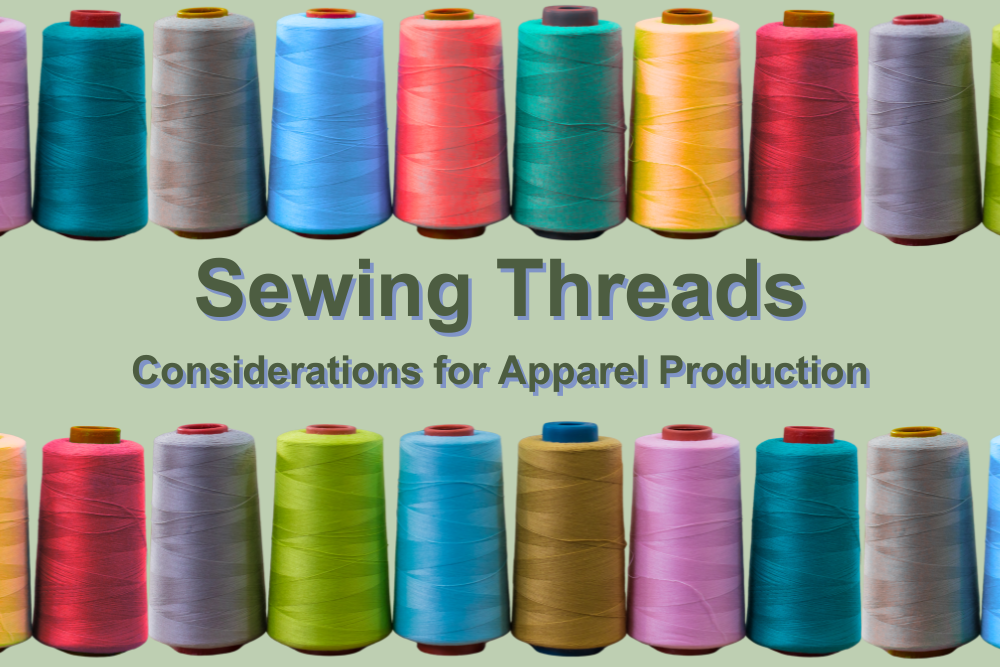
This Sewing Threads guide focuses on how professionals actually select threads in real production environments—considering seam performance, machine compatibility, fabric behavior, and long-term product durability.
1. Thread Selection Is a Structural Decision, Not a Trimming Choice
In professional apparel production, sewing thread is part of the garment’s structure.
A mismatch between fabric and thread can lead to:
- Seam puckering
- Thread breakage during sewing
- Reduced wash durability
- Premature seam failure
This is why many factories decide on thread at the same time as fabric, not after pattern completion.
2. Matching Thread to Fabric Behavior
Fabric Shrinkage & Heat Sensitivity
Threads and fabrics respond differently to:
- Steam pressing
- Industrial washing
- Heat setting
If shrinkage rates are mismatched, seams may distort even when sewing quality is high.
Best practice
- Polyester filament or core-spun threads for fabrics exposed to heat or washing
- Careful testing when pairing cotton fabrics with polyester threads
Stretch, Recovery, and Seam Flexibility
For knits or garments requiring movement:
- Thread elongation matters as much as fabric stretch
- Too-rigid threads cause seam popping even if strength is high
This is where thread engineering—not just material—becomes critical.
3. Thread Numbers Revisited: Why “Same Size” Is Not the Same
At this level, thread size should be understood as relative, not absolute.
Key considerations:
- Spun vs filament sizing standards differ
- Japanese JIS sizing does not translate directly overseas
- Machine tension settings change effective thread thickness
Professional approach
- Use dtex as a neutral comparison
- Always test seams at production speed, not just sample speed
4. Sewing Machine Compatibility & Production Stability
Thread performance depends heavily on:
- Needle type
- Machine speed
- Stitch density
- Lubrication level
High-quality threads are engineered to:
- Reduce lint buildup
- Maintain stable tension
- Minimize needle heat at high RPMs
This is one reason Japanese threads are widely used in high-precision sewing environments, even when produced overseas.
5. Why Japanese Thread Manufacturers Excel in Industrial Settings
Japanese thread makers are known not only for quality, but for production predictability.
Common strengths include:
- Extremely tight lot-to-lot variance
- Consistent dye depth
- Precise twist control
- Long-term machine stability
This makes them especially valuable for:
- Long-run programs
- Reorder-based production
- OEM / uniform manufacturing
6. Manufacturer Positioning (Contextual Overview)
Rather than repeating brand introductions, here’s how major Japanese manufacturers are typically positioned in professional production environments:
- FUJIX
Frequently selected for tailored garments and general apparel where a balance of seam appearance, strength, and machine stability is required. Cotton/Poly threads - GUNZE
Known for threads developed with a deep understanding of garment construction, fabric behavior, and long-term wear performance. - KINBA
Commonly used in mass-production environments where consistent quality and cost-performance are key priorities. - KIN HIDORI (TOSHIN)
Often associated with traditional techniques and specialty applications requiring refined finishes and controlled thread behavior. Silk Threads. - UJYO BUSSAN – (not currently available on ApparelX but can be arranged if requested. Please send us an inquiry! )
Known for functional, production-oriented threads such as UJ Cotton and UJ Core, which are widely used in apparel manufacturing that prioritizes sewing efficiency, seam stability, and repeatability. Their lineup is often selected when predictable performance across different fabrics and sewing conditions is required. Threads for deinm.
Each manufacturer brings distinct strengths to the table. At the professional level, thread selection is less about brand recognition and more about matching thread characteristics to fabric, machinery, and production goals.
7. Thread Testing: The Step Often Skipped (But Shouldn’t Be)
At an advanced level, thread testing should include:
- Wash testing
- Press testing
- Stress seam testing
- Long-run machine testing
Threads that perform well in sampling may behave differently after:
- 1,000 garments
- High-speed continuous sewing
- Repeated washing cycles
Final Thoughts: Sewing Thread as a Quality Lever
At the professional level, sewing thread is not just a consumable—it is a quality lever.
Understanding how thread interacts with fabric, machines, and production flow allows brands and factories to:
- Reduce defects
- Improve durability
- Stabilize production
- Maintain consistent product quality across seasons
Bridge the gap between material knowledge and manufacturing reality.
ApparelX is a BtoB ecommerce platform for brands, tailors and the like to order from small MOQs from a variety of manufacturers in one order. And we ship worldwide!
Check out our FAQ page, Youtube, and LinkedIn if you have basic questions or looking to stay connected.
Let ApparelX support your production needs through our apparel OEM service!
If you are looking to bulk order, custom order, or have any other questions, contact us through our contact form and a member on the Global Strategy Team will get back to you within the next business day. (Please understand that we are based in Japan and our office hours are 9am-6pm so we are only able to answer during that time).