

In March 2026, we exhibited at Intertextile Shanghai trade show for the first time. During the exhibition, we were so busy meeting visitors that we barely had time to explore other booths or source materials ourselves. We were happy to welcome many customers to our booth, including existing customers we had never met in person before. Overall, it was a very rewarding trade show experience.
That said, the show was physically demanding — we averaged more than 17,000 steps per day(per person of course), and it took some time to recover afterwards. Still, it was a great sense of accomplishment.
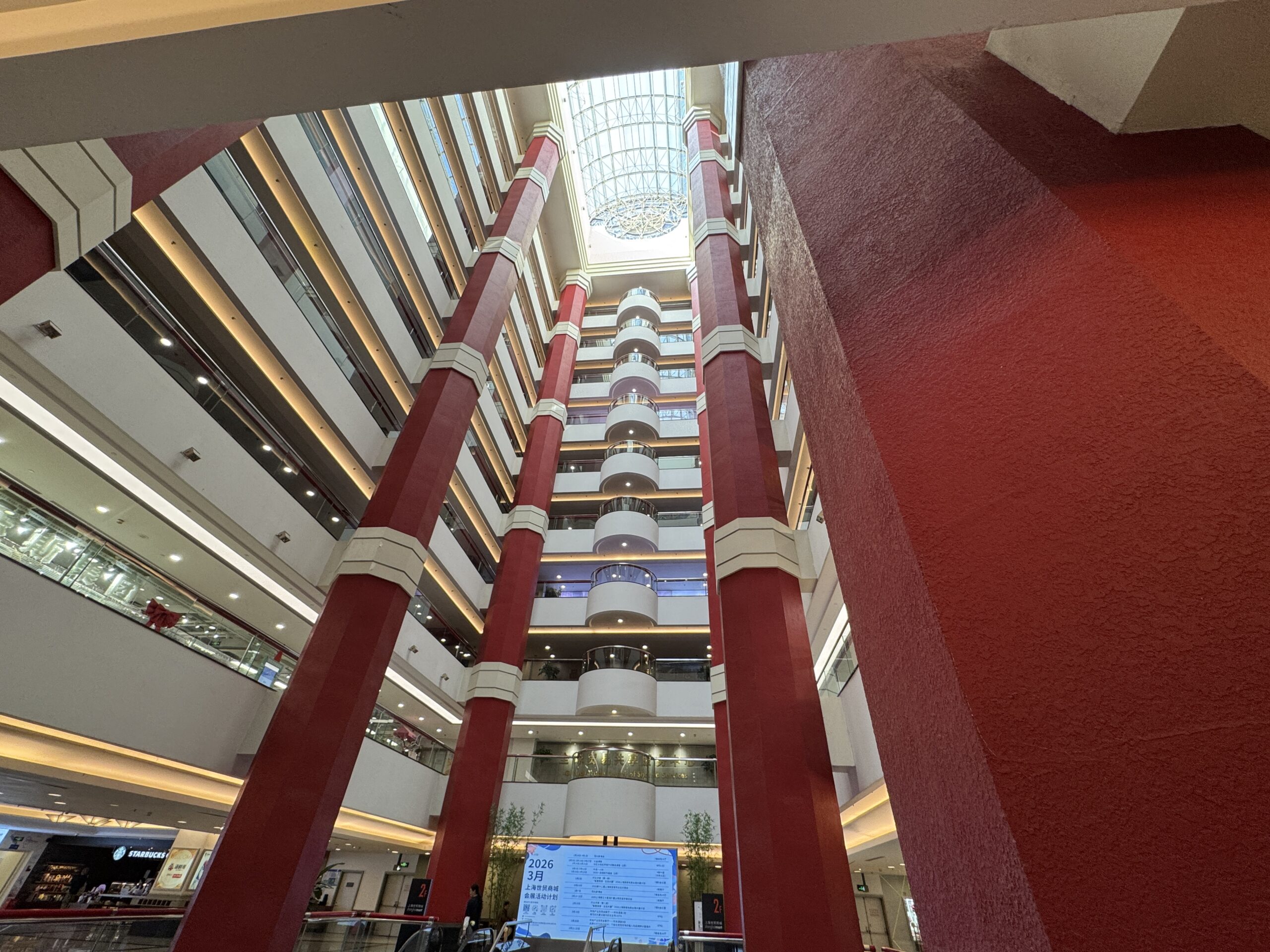
Before the exhibition, I had the opportunity to visit Shanghai Mart (Shanghai World Trade Center Mall), one of Shanghai’s well-known textile and sourcing hubs. Since many Japanese textile trading companies and trim suppliers have offices there, we wanted to see the current market environment firsthand and better understand the atmosphere of the local Chinese apparel industry.
What Is Shanghai Mart?
Shanghai Mart is a major international trade and sourcing center located in Shanghai. It combines wholesale showrooms, exhibition space, meeting facilities, and office functions under one roof, serving as a hub for global trade businesses.


We often saw Shanghai Mart mentioned in the Japanese textile industry media, but we had not fully grasped what kind of place it was until we visited in person.
We had previously visited Dongdaemun in Korea, so we initially imagined Shanghai Mart would have a similar atmosphere — a place where apparel manufacturers visit to source fabrics and trims for new collections and developments. In reality, however, it felt much more office-oriented than we expected.
Japanese Companies with Offices in Shanghai Mart
Shanghai Mart houses offices and showrooms for many Japanese textile manufacturers and globally active trim suppliers, including companies that we also work with at ApparelX.
Some examples include:
- Kuwamura
- Sasaki Sellm
- SHINDO (S.I.C.)
- KOKKOH/HOKKOH
- Nishikawa Keori
- Cosmo Textile
Most offices appeared to have teams of around three to four employees.
Many of these spaces functioned as both showrooms and sample delivery hubs. Roughly half of each office was dedicated to displaying sample books and product collections.
One interesting point was SHINDO’s setup. Similar to their Harajuku showroom in Tokyo, they were able to provide on-site ribbon cutting services directly from the showroom inventory. It showed how efficiently they support local sourcing needs in China.
📎 Showroom video below, it’s in Japanese but I hope you’re able to get the vibes.
The Atmosphere of Chinese Trading Companies


Of course, the building is not limited to Japanese companies. There were also many Chinese and international businesses operating offices there.
One thing that stood out was how familiar the fabric presentation style felt. Fabric sample books were neatly organized by article number on shelves, much like in Japan, and visitors were generally free to browse samples on their own.
When we asked about inventory, however, most companies seemed to carry only limited stock. The majority of products appeared to be made-to-order rather than available from immediate inventory.
We also noticed catalogs for Japanese trim brands displayed by local Chinese distributors or sales agents. Seeing Japanese-language sample books in Shanghai gave us a small sense of familiarity.
Overall Impressions
One thing that surprised us was how strongly the building smelled of cigarette smoke. It was noticeable enough that our team members who dislike smoking seemed uncomfortable throughout the visit.
Later, We learned from companies with offices there that Shanghai Mart previously had even more Japanese tenants. However, after a change in building ownership, rent increased and operating conditions became less convenient for Japanese companies, causing many businesses to relocate elsewhere.
As you move farther away from the central areas of the building, vacant office spaces become more visible, giving certain sections a somewhat empty atmosphere.


The fabric trading company offices themselves were generally open and welcoming, and visitors could freely browse materials. On the trim and accessory side, however, staff members closely monitored visitors, likely for security reasons.
For accessory components such as cord stoppers and hardware, the minimum order quantities appeared to start around 1,000 pieces, with pricing structured based on volume.
Final Thoughts
Whenever we exhibit overseas for the first time, we make it a point to conduct local market research as well. We visit fashion districts, wholesale markets, and sourcing areas — similar to how one might explore Nippori, Asakusabashi, or Sendagaya in Japan.
While every country has its own characteristics, China’s market structure feels somewhat different due to the scale of the country itself. Rather than concentrating all business activity in a single area, many companies seem to use these offices primarily as regional sales hubs while participating in exhibitions across multiple cities throughout the year.
Interestingly, while walking through Shanghai Mart, we saw very few apparel buyers actively sourcing products. Most people appeared to be staff members filming promotional videos or preparing sample books.
This visit reminded me that experiencing overseas markets firsthand is invaluable. There are many things you simply cannot understand without being there in person.
ApparelX is a BtoB ecommerce platform for brands, tailors and the like to order from small MOQs from a variety of manufacturers in one order. And we ship worldwide!
Check out our FAQ page, Youtube, and LinkedIn if you have basic questions or looking to stay connected.
Let ApparelX support your production needs through our apparel OEM service!
If you are looking to bulk order, custom order, or have any other questions, contact us through our contact form and a member on the Global Strategy Team will get back to you within the next business day. (Please understand that we are based in Japan and our office hours are 9am-6pm so we are only able to answer during that time).