

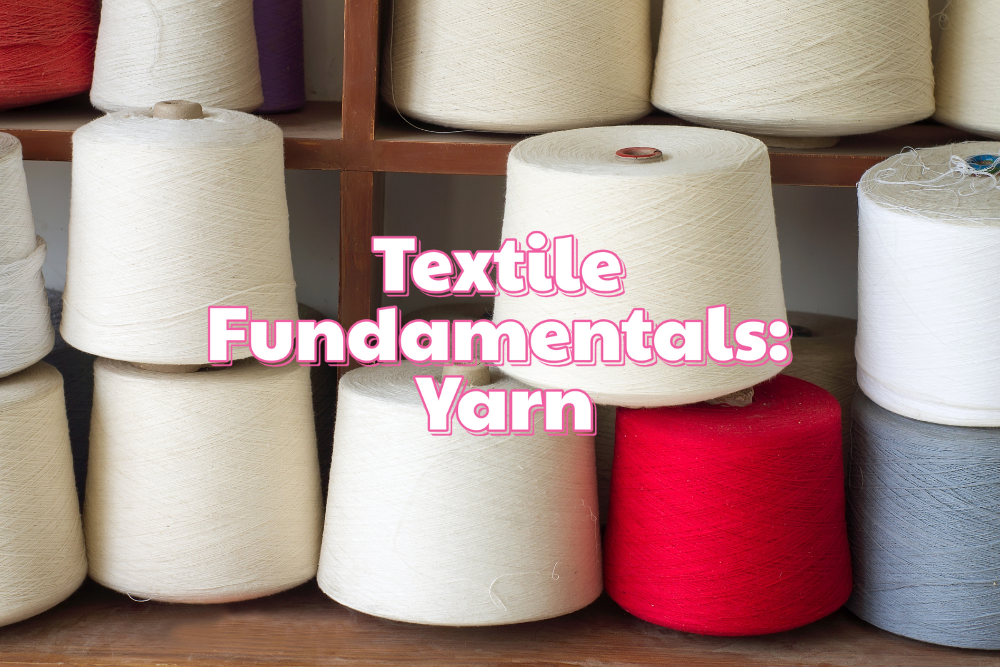
Part 2 of our “Basics of Fiber, Yarn, and Fabric” series
Once fibers are produced, they must be turned into yarn—the continuous strand of fibers used for knitting or weaving. Yarn construction directly affects the hand, drape, durability, and overall performance of the final fabric.
What Is Yarn?
Yarn is a continuous strand of fibers or filaments twisted together to form a usable length for textile production.
Two key categories exist:
- Staple Yarn – made from short fibers twisted together.
- Filament Yarn – made from long, continuous filaments, often extruded through a spinneret.
- a spinneret is like a shower head where the melted polymer is shot through tiny holes, cooled, and then twisted to form a yarn.
Spinning Methods
1. Staple Spinning
Short fibers (cotton, wool, or cut synthetic fibers) are drawn out and twisted to hold them together.
- Carded: Fibers are cleaned and aligned but retain some short fibers; softer, more casual fabrics.
- Combed: Additional processing removes short fibers, producing smoother, stronger, and finer yarns.
2. Filament Spinning
Synthetic polymers (like polyester or nylon) are melted or dissolved and extruded through a spinneret, forming long continuous filaments. These can be used as a single filament (monofilament) or grouped (multifilament).
Woolen vs. Worsted Yarns
- Woolen: Shorter fibers, loosely spun, airy and warm, with a fuzzy surface—ideal for sweaters or blankets.
- Worsted: Long fibers, tightly spun, smooth and strong—common in suiting and fine gauge knits.
Yarn Measurements and Structure
- Denier: Weight in grams of 9,000 meters of filament. Lower denier = finer yarn.
- Ply: Number of single yarns twisted together. Higher ply increases strength and thickness.
- Twist: The number of turns per inch or meter.
- S-Twist: Angled like the center stroke of an “S.”
- Z-Twist: Angled like the center stroke of a “Z.”
Twist level affects strength, stretch, and texture.

Specialty Yarn Types
| Yarn Type | Key Features | Common Uses |
|---|---|---|
| Slub | Thick-and-thin sections for visual texture | Casual shirtings, denim |
| Bouclé | Looped or curled surface | Jackets, upholstery |
| Chenille | Soft, velvety pile | Sweaters, accessories |
| Metallic | Metallic film or fiber for shimmer | Eveningwear, decorative trims |
| Elastic (Core-spun) | Spandex or rubber core wrapped with staple or filament | Stretch denim, activewear |
Why Yarn Construction Matters
- Fabric Hand & Drape: Finer, combed, high-twist yarns yield smoother, more elegant fabrics.
- Durability: Multiple plies and balanced twists increase strength and abrasion resistance.
- Aesthetic Effects: Specialty yarns such as slub or bouclé create distinctive textures without added finishing.
Practical Takeaway
From the soft warmth of woolen yarns to the sleek precision of worsted or filament yarns, understanding yarn construction helps you source the right textiles for your end use—whether that’s a crisp shirting, a plush knit, or a performance stretch fabric.
ApparelX is your global B2B partner for sourcing fabrics, trims, and accessories.
Stay tuned for Part 3 of this series: Fabric Construction and Weaves.
ApparelX is a BtoB ecommerce platform for brands, tailors and the like to order from small MOQs from a variety of manufacturers in one order. And we ship worldwide!
Check out our FAQ page, Youtube, and LinkedIn if you have basic questions or looking to stay connected.
Let ApparelX support your production needs through our apparel OEM service!
If you are looking to bulk order, custom order, or have any other questions, contact us through our contact form and a member on the Global Strategy Team will get back to you within the next business day. (Please understand that we are based in Japan and our office hours are 9am-6pm so we are only able to answer during that time).