

And how do you decide when sourcing?
For brands and developers working with pile fabrics, knowing whether to specify velvet, velveteen, or velour isn’t just about aesthetics — you need to consider performance, price point, production compatibility, and end-user expectations. While often grouped together for their surface texture, these textiles behave very differently in the cutting room and in the hands of consumers.
Whether you’re a designer seeking elegant fabric for eveningwear or a product developer sourcing for loungewear or children’s apparel, it’s important to know the difference. In this post, we’ll break it down and introduce some options from our site, ApparelX.
Read about Chubu Velveteen Co., Ltd’s Kumoi Beauty that has a key focus on corduroy and velveteen textiles below!
Velvet — For Deep Drape and Dimensional Color
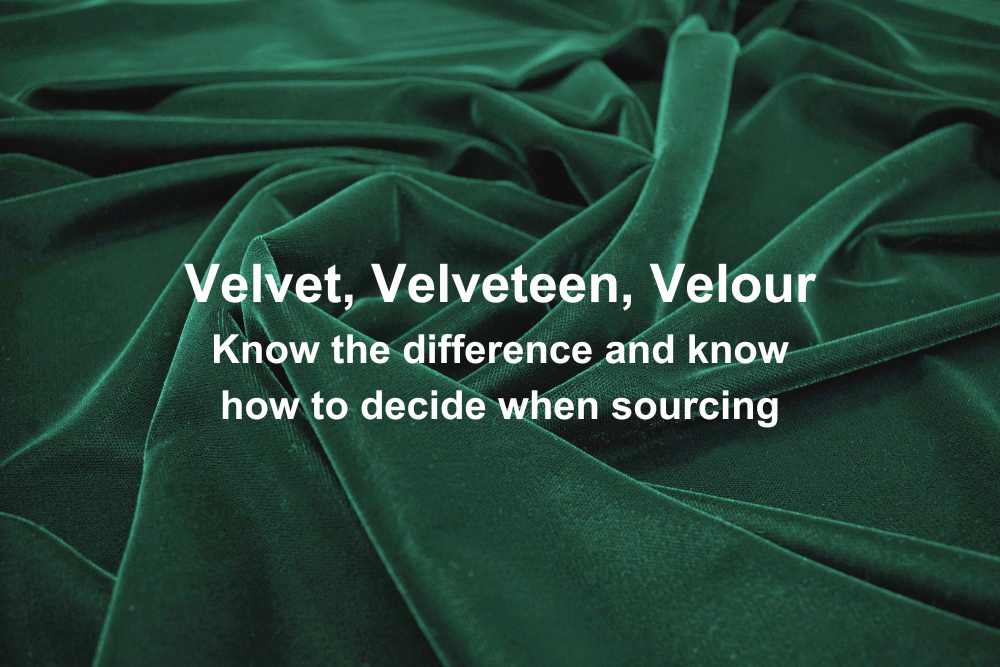
Velvet continues to dominate high-end eveningwear and fashion-forward collections for one key reason: its dimensional color depth and luxurious fluidity. The signature luster comes from a tightly woven base (often rayon or acetate in higher-end velvet) with a cut pile that reflects light differently depending on direction.
In production, velvet demands precision. It’s prone to bruising and pile crush during handling, so it requires skilled cutting and careful pressing. But when done right, it brings unmatched richness to tailored or draped garments.
🧵 Use this fabric when:
You want drama, softness, and visual depth — especially in structured dresses, coats, or stage costumes.
Let me introduce you to 3770 – Polyester Velvet, Glossy ,
This is a wrinkle-resistant polyester velvet.
It is glossy and the pile is made using bright yarns.


Velveteen — Structured, Matte, and Tailor-Friendly
Think of velveteen as the practical sibling to velvet — made with a cotton or cotton-blend base, offering more structure and a lower sheen. It’s ideal when you want the plush look without the slippage or shine that velvet brings.
It holds its shape, sews easily, and works well for both apparel and accessories. In menswear or children’s lines, velveteen often outperforms velvet for its stability and washability. It’s also a good alternative when cost or production speed is a concern.
🧵 Use this fabric when:
You need pile texture without the drama — especially in kidswear, fall/winter bottoms, or tailored casual jackets.
Let me introduce you to W13078 – Cotton Velveteen Special Washer Processing
It has excellent heat retention properties, making it suitable for autumn and winter clothing.


Velour — Stretch-Driven and Comfort-First
Unlike velvet or velveteen, velour is a knit pile fabric, offering stretch, softness, and ease of movement. It’s commonly used in loungewear, kidswear, and performance apparel — or anywhere the pile texture needs to coexist with functional movement.
With advancements in brushed knits and stretch velours, the gap between comfort and luxury continues to narrow — making velour a go-to for relaxed silhouettes that still feel elevated.
🧵 Use this fabric when:
Stretch and softness are non-negotiable — from athleisure to babywear to yoga-friendly fashion.
Let me introduce you to BL60000 – Tightly knit Velour.
This velour is made from cotton and polyester.


Corduroy — The Ribbed Alternative
While not always included in the velvet conversation, corduroy shares a common lineage with velveteen — it’s also a cotton pile weave, but with cut weft threads arranged into ribs (wales). Depending on wale count, corduroy can read as anything from refined to rugged.
Fine-wale (16+ wales per inch) makes a strong case for tailored shirting and dresses, while wide-wale is having a fashion resurgence in outerwear and accessories. It offers durability, surface texture, and a matte vintage vibe that pairs well with natural palettes.
🧵 Use this fabric when:
You want both texture and toughness — especially in fall/winter capsules or retro-inspired lines.
Let me introduce you to 2030 – 22W Light Summer Corduroy
Ultra fine wale at 22W, it is perfect for blouses and tops.


Final Notes: Don’t Let the Pile Fool You
Velvet, velveteen, velour, and corduroy may share a pile construction, but they are entirely different in production reality. Their distinctions affect every stage — from sourcing and cutting to customer wearability and care.
By working with specialty mills like Chubu Velveteen’s Kumoi Beauty, you can access japanese quality in your brand’s fabrics.
Need other recommendations? Reach out — we’re happy to guide you through the options.
ApparelX is a BtoB ecommerce platform for brands, tailors and the like to order from small MOQs from a variety of manufacturers in one order. And we ship worldwide!
Check out our FAQ page, Youtube, and LinkedIn if you have basic questions or looking to stay connected.
Let ApparelX support your production needs through our apparel OEM service!
If you are looking to bulk order, custom order, or have any other questions, contact us through our contact form and a member on the Global Strategy Team will get back to you within the next business day. (Please understand that we are based in Japan and our office hours are 9am-6pm so we are only able to answer during that time).